Why are sensory teams adopting AI?
Picture this: your R&D team has three strawberry yogurt prototypes, and 120 consumers have tasted them. You have liking scores, flavor and texture ratings, and dozens of open comments. The question from the steering committee is simple: which one do we launch?
Answering it rigorously usually means days of Excel, relying on the one person who really knows the statistics and, even then, ending up with "B seems to be the favorite". That is exactly where artificial intelligence is changing the way sensory teams work.
In this article, we explain what AI brings to sensory analysis, what it means for an AI to be agentic, how it helps at every stage of a study, and how MCP lets you set up studies just by talking to your AI assistant. All with real-world examples.
What can AI do in a sensory study?
AI in sensory analysis means using artificial intelligence models and advanced data analysis to understand how consumers perceive a product: its taste, aroma, texture, acceptance and preference. It doesn't replace your panel; it makes it stronger. People still do the tasting, and AI helps you understand what their answers mean.
Think about the bottlenecks of a traditional study:
- It's slow. Preparing scoresheets, coding samples and moving results from paper to Excel can take weeks before you reach a single conclusion.
- It depends on a few experts. If the person who knows how to read a preference analysis is on vacation, the study waits.
- It has no memory. One plant runs its tests one way, another plant in another country does it differently, and nobody can compare this year's results with those from three years ago.
And getting it wrong is expensive. According to Harvard Business Review, 75% of new consumer packaged goods fail to reach $7.5 million in sales in their first year. The most common reason isn't price or distribution: it's that the product doesn't connect with consumers on a sensory level. Taste is the number one driver of repeat purchase, ahead of price, packaging and advertising.
AI for sensory analysis works in any industry where consumer perception drives product decisions: food and beverage, cosmetics, personal care, ingredients, chemicals and consumer goods.
That's why Sensesbit was built the other way around: it started from sensory science and then developed the technology. It's a spin-off of the Universidade de Santiago de Compostela, founded by PhDs in sensory science, and a pioneer in bringing AI into sensory analysis. Today, more than 100 companies in over 11 markets use it to design, analyze and interpret their studies on a 100% cloud platform, with no installations or servers of their own.
What is agentic AI and how is it different from generative AI?
Agentic AI is a type of artificial intelligence that goes beyond answering or summarizing: it analyzes information, weighs up scenarios and recommends or takes actions to reach a goal. Generative AI, on the other hand, creates new content, such as text or images, based on what it has learned.
Back to our three yogurts:
- A generative AI would tell you something like: "Prototype B has the highest average score and consumers highlight its creamy texture." Useful, but you don't know whether that difference is real or just chance, or whether it justifies a launch.
- An agentic sensory AI would tell you: "B is the preferred option and its lead holds steady across thousands of simulations; A and C are not different from each other. Recommendation: launch B and stop investing in C." That's a decision you can take to the committee.
That's the idea behind SensAI, the world's first agentic sensory AI, launched by Sensesbit in 2026. It combines sensory science, statistics with up to 10,000 simulations and business logic to recommend which decision to make. It only uses generative AI to write the final report from results that have already been calculated.
How can AI help in sensory analysis? Examples at every stage
AI supports you across the whole study, from design to defending your results in front of leadership. For each stage, here's what AI brings in general and how it works with Sensesbit, using a consumer acceptance test for a new cookie recipe as an example:
| Stage |
What AI brings in general |
How it works with Sensesbit (example: new cookie recipe) |
| Design |
Cuts the repetitive work of setting up a study: drafting the questionnaire, choosing scales and organizing samples. |
You ask your AI assistant, connected through MCP: "Set up a session to compare our current cookie with two reduced-sugar recipes." The session, questionnaire and samples are created in the platform, ready for you to review. |
| Data collection |
No more copying paper forms into Excel, fewer errors, and data ready to analyze. |
Consumers answer in an online panel from their phones or in the lab on tablets, and responses land in the same platform where you designed the study. Samples are coded automatically, so nobody knows which one is the original recipe. |
| Analysis |
Calculates results as soon as data comes in and checks whether a difference is real or due to chance, even with small samples. |
Results are calculated in real time. With 60 consumers, SensAI's Data Booster tells you whether the difference between the current recipe and the reduced-sugar one is solid or whether you need more data. |
| Interpretation |
Agentic AI goes beyond the numbers: it spots patterns, prioritizes what matters to the business and recommends what to do. |
SensAI finds that the recipe with 20% less sugar doesn't lose liking but scores lower on crunchiness. Recommendation: launch it after adjusting the texture. |
| Reporting |
Generative AI writes the final report from the results, so it reaches decision-makers clearly. |
Executive Insights writes a one-page report for leadership from results that have already been calculated, with the evidence behind every conclusion. |
Each team gets something different out of it:
| Team |
Example |
| R&D |
Know which attribute to change in a prototype before the next iteration |
| Quality |
Check that the same product is perceived the same way in two different plants |
| Sensory analysis |
Set up in minutes a study that used to take hours of preparation |
| Innovation |
Bring a go/no-go backed by statistical evidence to the committee |
| Consumer Insights |
Pull out of 2,000 open comments what really drives preference |
| Marketing |
Back up a claim like "creamier" with how consumers actually perceive the product |
What is MCP and how does it help you set up sensory studies?
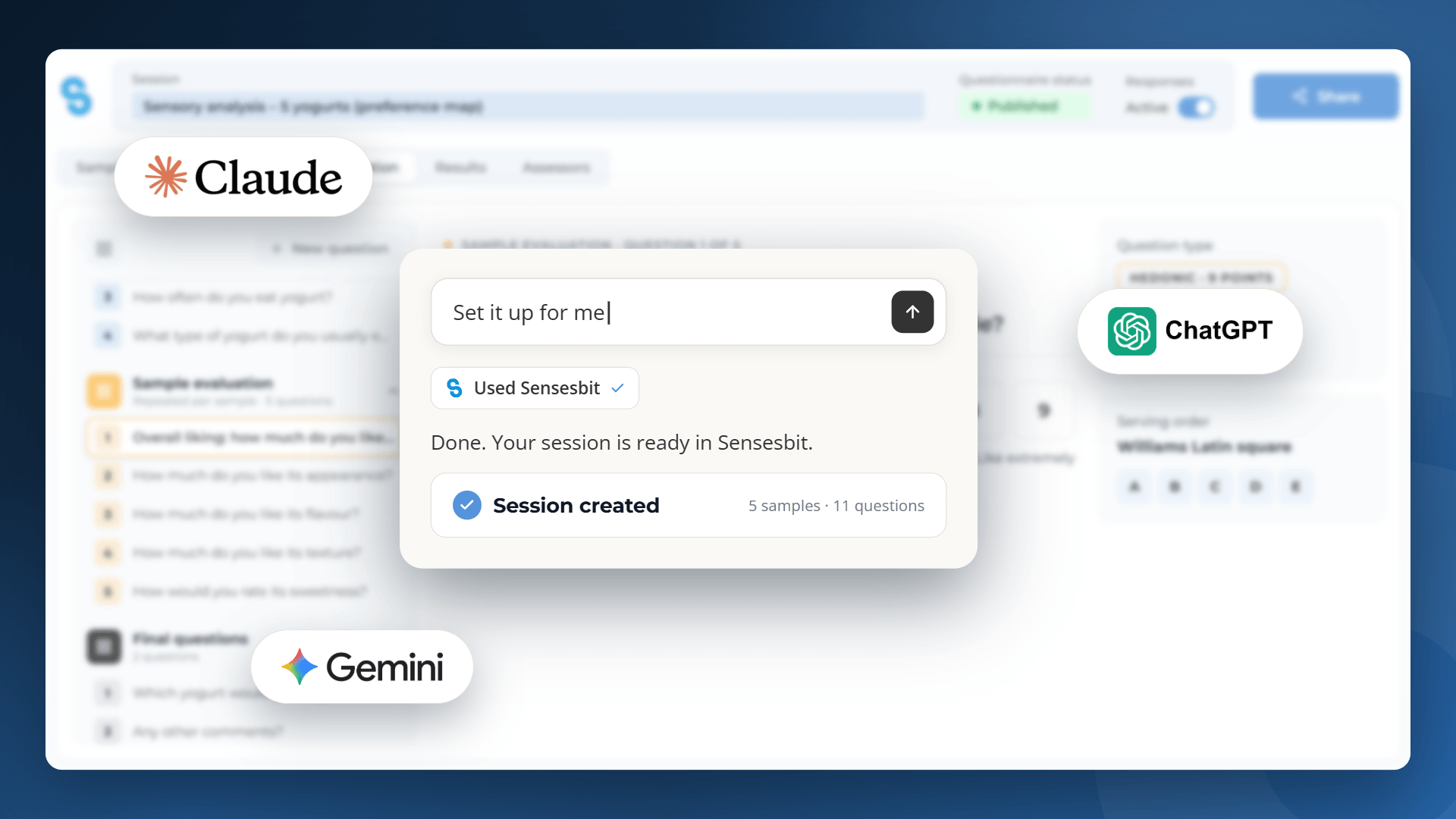
MCP (Model Context Protocol) is an open standard that connects AI assistants, such as Claude, to other applications so they can look up data and carry out tasks in them. In Sensesbit, it's one more feature of the platform: it connects your AI assistant to your sensory studies.
In practice, you work in Sensesbit by talking to your assistant instead of clicking through menus. Here are a few things you can ask:
- Create a full session: "Create an acceptance session for three orange juice prototypes, with a 9-point hedonic scale and a purchase intent question."
- Manage samples: "Add the samples for the new olive oil SKU and assign them to this week's session with their codes."
- Check a study's progress: "How many responses does the white wine tasting we published on Monday have?"
- Review results: "Show me the results by question for the cookie session."
The assistant prepares it in Sensesbit and your team reviews it before publishing. MCP speeds up the setup, and SensAI takes care of the analysis and the recommendation. Together, they shorten the path from "we have an idea for a study" to "we have a decision".
General-purpose AI, traditional software or sensory AI: how they differ
A general-purpose assistant helps you prepare studies or write, but not make product decisions: it won't calculate how confident you can be in a prototype or whether a difference is strong enough to support a claim. We cover this in detail in ChatGPT Can Summarize Sensory Data. Sensesbit Turns It Into Defensible Decisions. In short:
| |
General-purpose AI |
Traditional tools |
SensAI |
| What it does with your data |
Summarizes text |
Displays results |
Analyzes the evidence |
| Statistical rigor |
None |
Manual |
Up to 10,000 simulations |
| Business prioritization |
No |
No |
Tau value and market impact |
| Recommends a decision |
Generic |
No |
Defensible go/no-go |
| Defensible for claims |
No |
Partial |
Yes |
| Built for sensory |
No |
Yes |
Yes |
The core difference is this: traditional sensory software mainly collects and displays data, and interpreting it is still up to your team. Sensesbit combines sensory science, statistics and AI in a single platform to turn that data into a decision.
Is AI in sensory analysis worth it?
AI is already changing the way sensory teams work. With MCP, you set up studies in minutes from your AI assistant; with SensAI, you turn results into a recommendation you can defend in front of your committee.
Think back to the three yogurts: instead of days in Excel and a "B seems to be the favorite", you get a decision backed by evidence. That's what companies like PepsiCo, Damm, Calidad Pascual and Grupo Nueva Pescanova already do with Sensesbit, the sensory software that grows your business.
Does it pay off? According to Sensesbit's Sensory ROI™, digitizing sensory initiatives delivers an 11× return, 40% more engagement and repeat purchase, 30% higher willingness to pay and 8–12% more annual sales. And your data stays protected: Sensesbit is ISO 27001 and ISO 9001 certified and GDPR compliant.
Want to see how it works? Discover Sensesbit's sensory AI.
Join the conversation
Have a question or perspective to share? Leave a comment below.