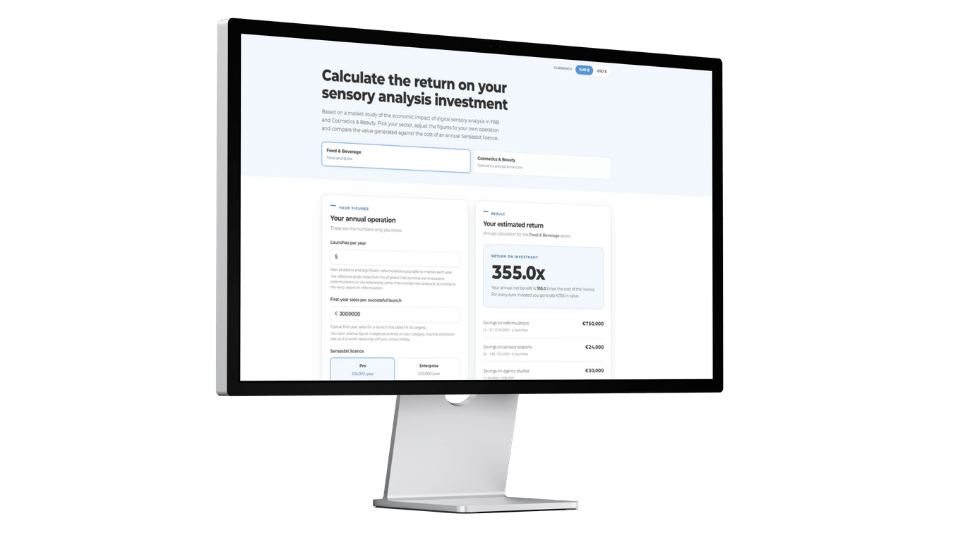
The ROI of sensory analysis software is what you save on reformulations, sensory sessions, agency studies and failed launches, plus the extra sales you gain, compared with the cost of the license. For a Food & Beverage company with 5 launches a year, cost savings alone exceed €2M a year under market assumptions. The same calculation measures the real impact of not having a systematized sensory process: the cost doesn't go away, it hides in time lost on every launch and in product decisions that go wrong. Here's how to calculate both.
What does sensory analysis software give you that paper or Excel can't?
Sensory analysis software lets you design, collect, analyze and interpret every sensory and consumer study on a single platform, with standardized data and a historical record. With paper or Excel, data ends up scattered across teams and plants, results can't be compared, and know-how depends on one or two experts.
How much time does sensory analysis software save?
Sensory analysis software saves time on every launch: fewer reformulation rounds, fewer sessions, fewer external studies, and a time-to-market around 5 weeks shorter. These are the market assumptions the Sensory ROI Calculator uses for F&B:
| What goes down | Without software | With software |
|---|---|---|
| Reformulations per launch | 3 | 2 |
| Sensory sessions per launch | 6 | 4.8 |
| Agency studies per year | 4 | 2.8 |
| Time to market | Baseline | 5 weeks earlier |
The 5 weeks come from health and beauty manufacturers that digitized their product information management. The same research links a 20% shorter cycle with an average 15% increase in margins. Every reformulation round and every session you skip means weeks of trials, panels and pilot plant your team can spend iterating instead.
To calculate how much time you lose today without a systematized process, answer three questions using your own track record:
- How many reformulation rounds does each launch need on average? Every extra round is another cycle of trials, panels and pilot plant.
- How many sensory sessions do you repeat just to confirm results? If you can't reuse data from past studies, every project starts from scratch.
- How many weeks pass between the first prototype and the go/no-go? Every week of delay is a week less of sales.
Multiply the extra rounds and sessions by their cost and by your launches per year. That's the time cost of not systematizing. Levers 1, 2 and 5 in the calculator do this for you.
How does not having sensory software affect product decisions?
The biggest cost lies in decisions. Over 80% of new consumer goods fail within their first 12 months, and the most common cause isn't price or distribution: it's that they don't connect with consumers on a sensory level. Taste is the number one driver of repeat purchase, ahead of price, packaging and advertising.
Without comparable sensory data, go/no-go calls come down to gut feeling, reformulations arrive too late and every project starts from zero.
To calculate the cost of those decisions, you need two figures your team already has:
- Your real failure rate: of the products you've launched in recent years, how many missed their sales target or were pulled?
- The cost of a failed launch: development, industrialization, marketing and trade activation. As a ballpark, the industry puts it at $1–2M per launch.
Multiply your launches per year by your failure rate and by that cost. The result is what you lose today by deciding without comparable sensory data. Lowering that rate by even a few points is usually the lever that weighs most: in the example below, it accounts for more than half of the savings. Lever 4 in the calculator works it out with your data.
How do you calculate the ROI of sensory analysis software?
The ROI of sensory analysis software compares the value it generates in a year with what the license costs. That value comes from five levers:
- Fewer reformulations per launch.
- Fewer sensory sessions thanks to reusable data.
- Fewer agency studies, handled with your own panel and historical data.
- Fewer failed launches, by validating before scaling.
- More sales, by launching sooner and with a higher success rate.
The weight of each lever varies a lot depending on your sector, your launches and your costs. The Sensory ROI Calculator already includes the formulas and market benchmarks for each one: you just add your data.
ROI example for a Food & Beverage company
An F&B company with 5 launches a year would save around €2M a year in costs under the calculator's market assumptions, before counting any sales uplift.
More than half of those savings come from a single lever: avoiding failed launches. The second is reformulating less.
What about you? It depends on your launches, your costs and your sector. Calculate your Sensory ROI with your own data and download the full breakdown as a PDF.
How to calculate your ROI in under 5 minutes
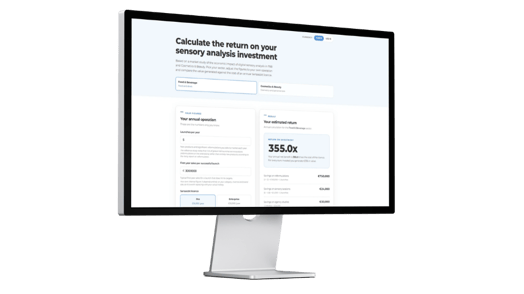
- Go to the Sensory ROI Calculator and choose your sector: Food & Beverage or Cosmetics & Beauty.
- Enter your launches per year and the first-year sales of a successful launch.
- Replace each lever's assumptions with your real track record, especially your agency spend.
- Compare conservative, mid and aggressive scenarios, and download the result as a PDF.
For reference, according to Sensesbit's Sensory ROI™, digitized sensory initiatives deliver an 11× return, +40% engagement and repeat purchase, +30% willingness to pay and +8–12% annual sales.
From data to decision
The return on sensory analysis software isn't just about saving hours: it's about walking into the committee with a go/no-go you can defend, and never starting from scratch again. Sensesbit brings the design, collection, analysis and interpretation of your studies together, and with SensAI, the world's first agentic sensory AI, you go from results to a recommendation.
The first step is knowing what it could deliver for you. Calculate your Sensory ROI.
Join the conversation
Have a question or perspective to share? Leave a comment below.